|
Pride of Yorkshire
Magnificent Castle Howard stands proud after centuries of uncertainty and neglect, writes Craig Roberts.
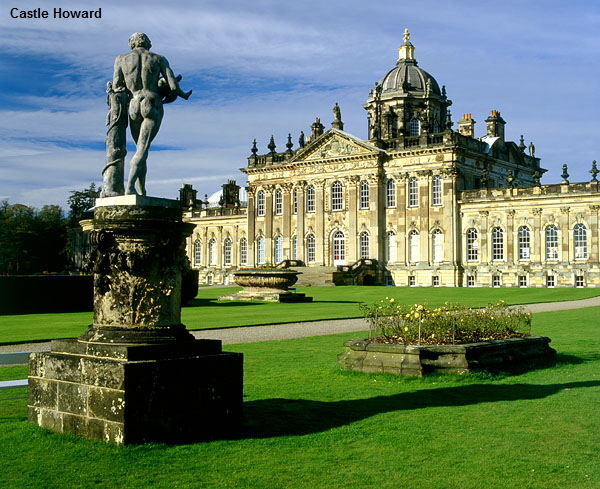
The idea that a successful dramatist with no experience of architecture could create such a grand looking house seems quite obscure and indeed raised a few eyebrows at London’s Kit-Cat Club. Nonetheless, John Vanbrugh was the fellow member that Charles Howard, 3rd Earl of Carlisle turned to in 1699, when leading architect William Talman’s ideas failed to enlighten him. Wisely though, Vanbrugh enlisted the help of professional architect and assistant to Sir Christopher Wren, Nicholas Hawksmoor to create the flamboyant Baroque design that he envisaged.
It took over a century for the house to be built, which spanned the lives of three Earls. It was quite original in its approach, with a north/south axis as opposed to the traditional east/west to take advantage of the prevailing views and also became the first private residence in England to feature a dome. Although Vanbrugh died in 1726 before its completion, the house had already become the talk of 18th century society and established Vanbrugh as the preferred choice over Christopher Wren in designing Blenheim Palace.
Indeed the house was still under completion when Carlisle died in 1758, the house eventually finished by his son-in-law, Sir Thomas Robinson using a more subdued Palladian design on the then unfinished West Wing. This would surely have displeased Vanbrugh as it did the 4th Earl, Henry who was deeply regretting Robinson’s work. His family was also mystified at their father’s decision to build a new wing “not corespondent to the other, or to the centre part of the House”.
Further changes were unpredictably brought on many years later when on November 9th 1940 a fire broke out in the South East Wing devastating twenty rooms in its wake, before sweeping through the house, into the Great Hall and completely destroying the dome. This inevitably left the house a gutted shell, open to the elements and many thought this would be the downfall of the Yorkshire house.
After World War II though, George Howard returned, inheriting the house after his two brothers, Mark and Christopher were unfortunately killed in battle. The family trustees had already begun to sell most of the contents, thinking that the house was never to be used again. To everyone’s astonishment though, George made the dauntless decision to move back to the family home and together with his wife Lady Cecilia Fitzroy, embarked on the massive task of restoring the ruined house. Perseverance paying through and against all odds the house was reopened to the public in 1952.
The house was then re-crowned in 1962 when the dome was rebuilt and in 1979 the house was given another huge boost when it was decided by Granada Television to use it as the location for the adaptation of Evelyn Waugh’s Brideshead Revisited. Was this how Waugh envisaged his Brideshead, we can only speculate?
This unexpected revenue though, helped in the renovation of the Garden Hall and actively encouraged further restoration to the house and grounds, which is now overseen by present owner, the Honourable Simon Howard and his wife Rebecca.
Visitors on the tour enter the house through the West Wing. The East Wing is occupied by the family and not open to the public, with the South East Wing now open as an exhibition to the restoration work of the last 50 years.
The Grand Staircase opens the tour and features portraits of the first six Earls of Carlisle and leads up to the China Landing. From here it leads off to the two main bedrooms, Lady Georgiana's and the Castle Howard each with an adjoining dressing room. Lady Georginia was the wife of George, the 6th Earl and the Castle Howard Dressing Room has on display the bed that Queen Victoria slept in during her visit in 1850.
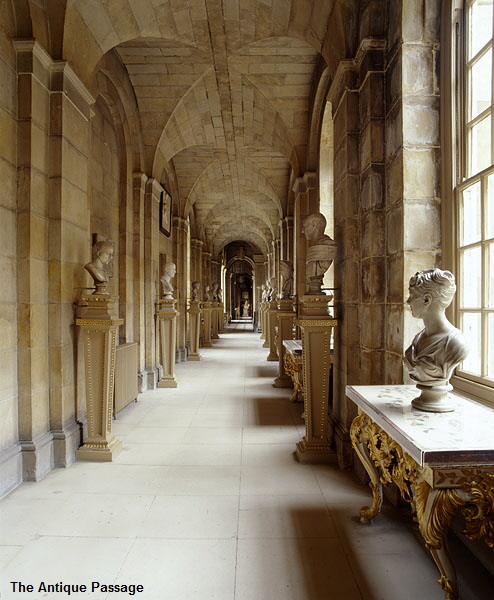
The tour continues to the Great Hall via the Antique Passage. Lined with antique busts and statues, these long corridors provided the present Simon Howard with an ideal roller-skating run as a boy. The Fortuna statue at the west end of the passage is believed to haunted.
Emerging from the Antique Passage into the Great Hall one cannot fail to be moved by this dramatic stage of shape and form illustrating Vanbrugh’s unique understanding of architecture. Four immense columns support the dome above, and casting the eye upwards it bears a similar resemblance to St. Paul’s Cathedral’s dome. In fact it was built when St. Paul’s dome was still on the drawing board. It’s elegantly decorated around the base with paintings of the Four Elements by Giovanni Pellegrini, while high above the gallery is a depiction of Phaeton falling from his father’s chariot. The hall has become a traditional place for the family’s Christmas festivities.
The South West front is divided into five rooms. Leading on from the Garden Hall is the Cabinet Room, which features a display, dedicated to the Brideshead Revisited production. While the Music Room illustrates how important music was to the family and features two pianos dating from the 18th century.
The Orleans Room was intended by the 5th Earl as a room for displaying his works of art. It was so called as it contained the Orleans collection of paintings by Philip of Orleans, the nephew to Louis XIV, purchased by the Earl in 1803. It is now affectionately known as the Turquoise Room, due to the present decor that recreates its 18th century look.
The Long Gallery runs almost the entire length of the West Wing. Divided into two by the Octagon, it too was intended as a display gallery but was also used by the family and children as a recreational area. The great size of this room is due to Robinson’s reworked design. The north end features works of art by Paolo Pannini, depicting scenes of classical Rome. This passion for Rome that Carlisle had is echoed all around the house and grounds.
The Chapel is a common addition in many stately homes and features decorated pillars and paintings of Christ and the Old Testament. The stained glass windows were designed by Burne-Jones and also feature depictions of Christ. The family regularly uses the chapel for services and special religious occasions.
The 10,000 acres of grounds are of equal grandeur to the house itself, and are among the most memorable parks in England. Even from the approach to the house it is obvious to the visitor the importance of architecture. In fact the combination of sweeping views and monumental buildings gives it a power like no other, that not even Stowe or Stourhead can match.
As you approach down the long, straight avenue, you pass through the narrow Cattiere and Gatehouse arches that feature a mixture of Gothic Roman and Egyptian styles. In the distance mock fortifications come into view as does The Pyramid. This stark, pointed shape featuring a bust of Lord William Howard, belies its Egyptian undertones and suggests a connection with the Mausoleum of Caius Cestius in Rome. A right turn at the towering obelisk brings the house into view, fronted by the Stable Courtyard.
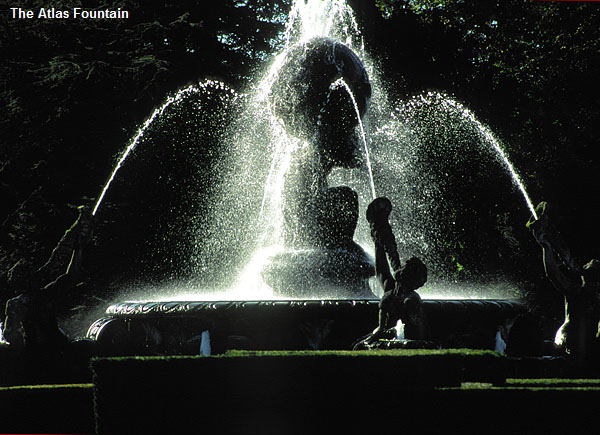
The South Parterre has changed significantly from Vanbrugh and Carlisle’s original designs. The 7th Earl commissioned William Nesfield in 1853, who expensively re-landscaped the lawn and also installed the Atlas fountain. Carved from Portland stone by John Thomas, the fountain was transported to Yorkshire by steam train. Further changes by the 9th Countess in 1894 simplified the area Nesfield had created to reduce the high maintenance costs.
Ray wood stands on the site of an ancient woodland and contains the reservoir that supplies water to the lakes and fountains. The wood contains over 800 species of rhododendrons and provides a delightful, alternative route to the Temple of Four Winds. The main path to the temple, known as Temple Terrace is lined with statues of Bacchus, Hercules and Meleager.
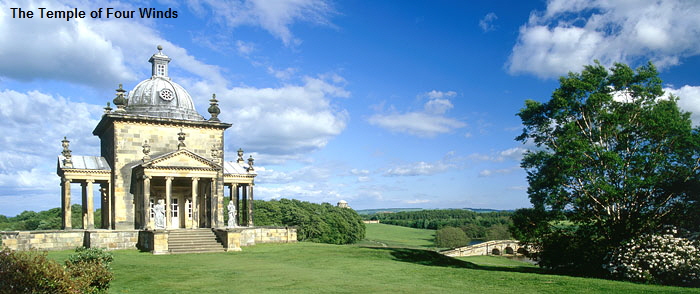
The Temple of Four Winds was originally called the Temple of Diana, after the Roman goddess of hunting. Featuring a dome and four porticoes, it was designed by Vanbrugh and based on Andrea Palladio’s Villa Rotonda in Vicenza. Its classical design along with sweeping views provided the ideal romantic setting for Simon Howard’s wedding.
From here you can see in the distance the New River Bridge and the Mausoleum. The Mausoleum was designed as a burial chamber after the 3rd Earl wrote in his will “ I do design to build a burial place near my seat of Castle Howard, where I desire to be layed”. The finished design of a colonnade differs from Hawksmoor's original after intervention by Lord Burlington. This delayed its completion and it wasn’t until six years after his death that the Earl was eventually laid to rest inside.
The lakes and ponds in the grounds are all artificial and fed by the reservoirs from Ray Wood. Therefore both the Atlas fountain and the Prince of Wales fountain in the South Lake rely on both gravity and changing water levels to operate. The water flows from the main South Lake, continues over the Cascade at one end before dropping 18 ft over the Waterfall to flow under the New River Bridge.
The intention is for a deceptive view from house of a continuous flow of water, to which visitors are then pleasantly surprised by unexpected level changes as they walk around the grounds. The grounds are completed with the delightful Rose Gardens, part of which are dedicated to Cecilia Howard and feature an impressive collection of modern roses.
This could have been just another country house that Carlisle, Vanbrugh and Hawksmoor were to design, and also just a memory if not for the dedication of George Howard. Instead, it is a house for others to be judged by, a testimony to the Howard legacy and a little bit of Rome in Yorkshire’s back garden.
All images and text copyright © Craig Roberts 2008
|